


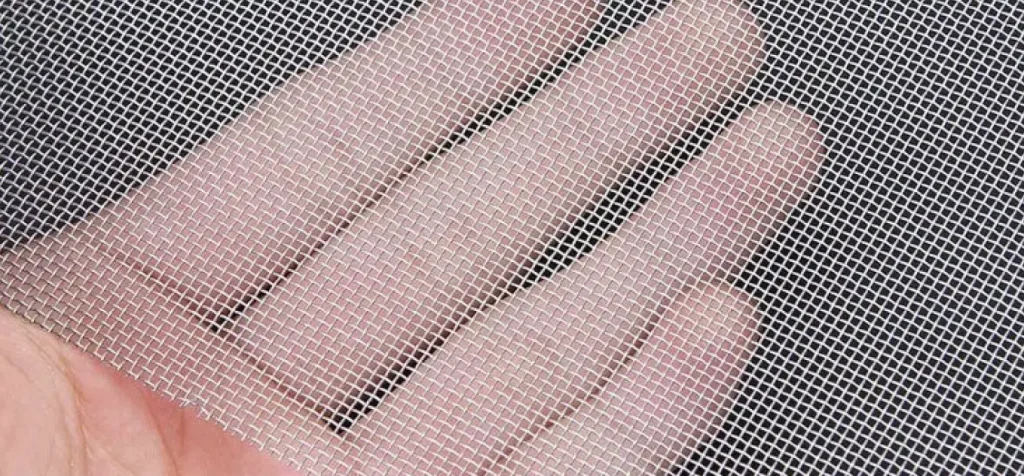
When selecting the right mesh filter size, you need to determine the particle size to be filtered, the required filtration efficiency, and the acceptable pressure and flow rate.
This means understanding three key parameters — mesh count, wire diameter, and micron rating.
Knowing how these specifications work together will help you balance filtration precision, strength, and flow capacity.
Mesh Filter Size
Mesh count refers to the number of openings per linear inch of mesh. It is one of the key factors that determines the performance of a mesh filter.
Examples of Mesh Count
110 mesh count screen — there are 110 openings in one linear inch of the mesh. Often used in screen printing mesh for medium-fine detail.
160 mesh count screen printing — there are 160 openings in one linear inch. This allows for finer detail and is suitable for printing thinner inks or high-resolution patterns.
200 mesh count screen — there are 200 openings in one linear inch, providing very fine particle retention and precise filtration.
Mesh Density vs Opening Size

1.Higher mesh count = smaller openings, higher filtration precision, but lower flow rate.
2.Lower mesh count = larger openings, higher flow rate, but lower filtration precision.
3.Example Table
| Mesh Count | Openings/Inch | Typical Use |
| 100 mesh | 100 | Fine particles filtration |
| 20 mesh | 20 | Coarse filtration |
Wire Diameter
Wire diameter is the thickness of each wire in the filter mesh, and it’s closely related to the mesh count.
1.The higher the mesh count, the thinner the wire must be.
2.Otherwise, the wires simply wouldn’t fit into the given space.
3.For example, a 1 mm thick wire cannot be used to make a 200 mesh filter,because the openings would be too small to weave properly.
4. Conversely, coarse meshes (such as 10 mesh) can use much thicker wires for strength.
Impact on Performance
1.Directly affects filtration precision and flow capacity.
2.Must be balanced with wire diameter for optimal strength.
3.Contact FUDAS for customized sizes.
Mesh Size vs Micron
Explanation
Mesh size refers to the number of openings per linear inch of a mesh filter, while micron measures the actual size of those openings.
1 micron = 0.001 millimeters
Smaller micron rating = finer filtration (traps smaller particles)
Larger micron rating = coarser filtration (lets bigger particles pass)
Although mesh size and micron rating are related, they are not the same. Mesh size tells you how many openings there are; micron rating tells you how big those openings actually are.
Analysis
Here is a reference chart based on the ASTM E11 standard, showing common mesh sizes and their approximate opening sizes in microns:
| Mesh CountApprox | Opening (μm) |
| 100 mesh | 149 μm |
| 140 mesh | 105 μm |
| 200 mesh | 74 μm |
| 270 mesh | 53 μm |
Applications

Micron filter rating is widely used to specify filtration precision in different applications:
1.Drinking water filtration – Often uses 0.5–5 micron filters (micron rating in water filters) to remove fine sediment and microorganisms.
2.Engine and hydraulic oil filtration – Typically 10–40 micron filters (micron rating on oil filters) to balance contaminant removal with flow rate.
3.Plastic extrusion machines – Around 105 micron filters to remove impurities from molten plastic.
Note: For high-precision filtration in water or oil applications, sintered filter may be required. We will cover this in detail in our next article.
How to Choose the Right Filter Mesh Size
1.Identify the Filtration Target
Decide the smallest particle size you need to remove. This determines your micron filter rating.
2.Consider Flow and Pressure
High flow and low pressure need a lower mesh count; high precision or high pressure may require a higher mesh count.
3.Select the Right Material
304/316 stainless steel for water and food; 316L or nickel alloys for chemicals and high corrosion resistance.
4.Balance Wire Diameter and Strength
Higher mesh counts need thinner wires; lower mesh counts can use thicker wires for better durability.
5.For Ultra-High Precision
Single-layer woven mesh is limited; choose sintered mesh or multi-layer mesh for micron ratings under 20 μm.
6.Contact FUDAS for Custom Solutions
We match mesh size, micron rating, and material to your needs. If stock matches, delivery can be as fast as 5 days.
Conclusion
The right filter mesh size balances mesh count, wire diameter, and micron rating for the best performance.
For ultra-fine filtration under 20 μm, single-layer mesh may not be enough — sintered filter wire mesh could be the solution.
Next: We’ll cover what sintered filters is and why it’s perfect for high-precision filtration.
